Showing posts with label Books. Show all posts

Wednesday, April 1, 2015

The Start of Me and Emery and Books

On January 20, 2011, I received an email from a virtual stranger. Attached was a 50-page sample of a manuscript about a teenage girl with an amazing group of friends attempting to reinvent herself.

Would I be willing to read it and give some feedback?

At that time the sender of that email, Emery Lord, and I were in similar situations. We were both 20-something Midwesterners with similar backgrounds. We'd both just finished writing our first complete manuscripts and were trying to figure out what to do next. We didn't really know many other writers. Even though I'd never critiqued anything before, a mutual writer friend introduced us. We agreed to exchange pages and give whatever feedback we could. Four years later, Emery and I both have literary agents, I have an awesome job as an editor, and she has two gorgeous books out in the world with a third on its way. Best of all, she's become one of my best friends.

Those original pages Emery sent me became THE START OF ME AND YOU, which released yesterday. It's a smart, lovely book full of heart and humor and people who care about each other. I love this book for many, many reasons, not the least of which is that it was the start of our friendship, but it was also the start of our professional writing endeavors. Independently we learned how to finish a manuscript. Together we learned how to query, how to edit, how to do it again and again and again. Together we learned how to try new things and see things differently. The more I look back at the last four years, the more I realize that the themes contained in this young adult book - themes of reinvention, of trying new things, of seeing things differently - are timeless. These are lessons we learn and forget and relearn again, and I love that this book reminds me of that.

On Tuesday, March 31, 2015, I drove from Chicago to Cincinnati to attend the launch party for THE START OF ME AND YOU at Joseph-Beth Books (and every time I visit Cincinnati I'm reminded that it's one of America's secret gems).

Emery joined young adult authors David Arnold, Kate Hattemer, and Courtney Stevens in an hour long panel discussion followed by lots and lots of book signing. David Arnold, in a stroke of genius, brought a copy of his book for the readers to sign for him, sort of like a year book. Emery brought boxes of donuts to share with the crowd.

Courtney recounting the amazing origin story for her book FAKING NORMAL (I can't do it justice here), and Kate answered questions about poetry and utilized her fluent Latin. Jasmine Warga tried to blend in with the audience but ended up signing a few of her books too.

Every writer I know has at one point or another considered shelving a completed project. Maybe it doesn't appear to fit the market, or agents are only responding with form rejections. Maybe it's been shopped to editors and no one bought it. The last line from that very first email I received from Emery back in 2011: "I guess I need to know whether or not this thing has a shot or if I should let it be and move on." We finally have the answer, and I couldn't be prouder of my friend and everything she's accomplished.

Thursday, March 12, 2015

March Reads: Doll Bones, Jackaby, The Girl on the Train, The Raven Boys

In college I had a professor who encouraged me to free write a few hundred words whenever I finished reading something. Over time it's proven to be wise advice.
THE GIRL ON THE TRAIN by Paula Hawkins

I picked up this book because my friend Julie Hammerle called it a "thrillery thriller." It's a book about messed up grownups. Grownups struggling with grownup problems like alcoholism and divorce and unemployment. But beyond all of that, it's a "wife gone missing" thriller along a similar line as GONE GIRL, but with what many might consider a more satisfying ending.

The story is written from multiple first-person female perspectives: Rachel, recently divorced train rider; Anna, mistress turned wife with trust issues; and Megan, the one who goes missing. I can't remember reading a book written in three first person voices before, so right away it has an added level of difficulty. The structure is compelling, divided by narrators as well as "morning" and "evening" (as though mimicking both legs of a commute). Each day, when her train stops at the signal, Rachel looks longingly over a back fence into the lives of a seemingly perfect couple. The trouble starts when she sees the perfect wife, Megan, with another man... and then a few hours later sees a report on the news that Megan has gone missing. Rachel feels compelled to tell the authorities what she saw, but the more we learn about Rachel, the more we wonder whether or not she's actually a reliable witness. It's not my favorite sort of book, but it is the sort of thing I enjoy in small doses.

JACKABY by William Ritter

On the other hand, JACKABY is like if Sherlock and Doctor Who had a baby. This, in fact, is exactly my favorite sort of book. I could not have been more delighted. There's an eccentric detective that can see paranormal activity that no one else can see. There's a young female English assistant (and a second assistant, who happens to be a duck). And MONSTERS. The main difference is setting: 1890s America, instead of modern day England. The pacing and energy and tone are all perfect for someone like me, who adores the Cumberbatchy/Tennant-ness of BBC TV. It was a quick, easy, fun read that left me feeling generally happy. There's a second book coming out in September called BEASTLY BONES, which will get a priority spot on my to-read stack.


DOLL BONES by Holly Black

This was a different read for me, in that it features younger characters (age 12) and several cool illustrations, kind of like the earlier Harry Potter books, but with creepier (think Tim Burton) undertones. A trio of friends, two girls and a boy, play-act stories with dolls and action figures and end up going on a real-life quest (I'm not sure I can say more without getting spoilery, but they do at one point sail and sink a boat). This book touches on gender roles in play and toys, on relationships between fathers and sons, on how friendships shift as kids grow older - so many lovely bits of substance in the midst of an adventure story with just a touch of magic.

THE RAVEN BOYS by Maggie Stiefvater

This was one of those times Emery Lord dropped a book recommendation bomb and then watched me lose my mind (one of her favorite hobbies). This book has everything (said in Stefon voice), but what really made it for me was the exquisite character building (and there are a LOT of characters). It was like Maggie Stiefvater built these people with tiny Lego bricks, one phrase at a time, until they were each big and beautiful and real and I just wanted to BE with them. She wrote deep friendship dynamics, and I felt the give-and-take of their personal goals versus their loyalties to each other.

Enough vague praise - to be a little more specific, this is a story of (mostly) rich private school boys colliding with the everyday people of their adopted hometown (including some quirky psychics). There's Adam, the kid from the wrong side of the tracks trying to make something of himself despite discouragement at home. There's Ronan, the sharp around the edges trust fund kid who acts like he doesn't care about anyone yet takes care to feed his rescued bird every two hours. And quiet, reclusive Noah, who at first kind of brought to my mind the guy from the movie The Great Outdoors who'd been struck by lightning multiple times and as a result was just a little squeamish about everything. Richard Gansey III is the glue that holds everyone together (he kind of reminded me of Hale from the HEIST SOCIETY books, but with many, many more Alpha tendencies). He's heart of gold meets foot-in-mouth. To quote the book (when viewed from Adam's perspective): "...Adam could forgive that shallow, glossy version of Gansey he'd first met. Because of his money and his good family name, because of his handsome smile and his easy laugh, because he liked people and (despite his fears to the contrary) they liked him back, Gansey could've had any and all of the friends that he wanted. Instead he had chosen the three of them, three guys who should've, for three different reasons, been friendless."

When I read that snippet, I fell in love with this book. It has paranormal elements. It has magic. It flirts with romance, when a local girl (who thinks of Gansey as "President Cell Phone") starts hanging around the boys, helping them with their quest, which has something of a modern day Arthurian feel to it. There are three total books in this series, and I'm thrilled; I'm not ready to give these people up just yet.

And one more thing. A lot of books have plot twists. Some are better executed than others. Some get a little too cute. Some act like they're getting away with something. THIS book manages to execute a dramatic plot twist while actually stating that twist plainly. In blunt language. At the very beginning. This book never lies to you, never withholds any information, gives you everything you need to know right up front... and twists you just the same. Really, really impressive stuff.

Upcoming Want to Reads: I still need to read ANOMALY by Tonya Kuper, must make it a priority; THE CONSPIRACY OF US by Maggie Hall, TRUST ME I'M LYING by Mary Elizabeth Summer, THE SHADOW CABINET by Maureen Johnson, THE INFINITE by Lori M. Lee, and I finally picked up THE RED QUEEN by Victoria Aveyard.

Tuesday, February 10, 2015

Read then Write: ILLUSIVE, FAR FROM HERE, ISCARIOT, FOOL ME TWICE

In college I had a professor who encouraged me to free write a few hundred words whenever I finished reading something. Over time it's proven to be wise advice.

It's been a pretty diverse month over here at the Robison Reading Nook. We've got a superhero story, some introspective women's fiction, historical Biblical fiction, and a rom-com. Something for everyone!

ILLUSIVE (Emily Lloyd-Jones) is a young adult sci-fi/comic-bookish story that gives an alternate take on the current vaccination controversy (kidding, kidding, but kind of not kidding).
The premise:

"Once upon a time, there was a pandemic. It was a new strain of meningococcal disease. Named Meningococcas Krinotas - or simply the MK plague - it embodied the worst traits of both viral and bacterial meningitis. Because it was a virus, anticiotics had no effect, and the current viral vaccines were ineffective. The result was a disease that, when diagnosed, was always followed by a funeral."

So a doctor developed a vaccine, and that vaccine gave a small percentage of the population special "immunities" - like telepathy, perfect recall, increased intuition, levitation, and the ability to create illusions. And once the doctor saw what his vaccine could do, he destroyed it so prevent more "immunities" from manifesting. Those who have immunities (or, what I could call "super powers") are hunted down and recruited by the government and criminals in equal measure. ILLUSIVE bounces back and forth between an criminal and a fed.

This was a really fun book with a delightful and diverse cast of characters, plenty of action and solid platonic (refreshing) relationships. It also had one of the great character names I've ever come across: Kit Copperfield, a kindhearted criminal who kind of reminded me of Fagin from Oliver Twist, if Fagan had boatloads of money and fine taste in art.

(Note: The second book in the series, DECEPTIVE releases in July 2015)

FAR FROM HERE (Nikki Baart) was introduced to me as "Women's Fiction/Book Club Fiction" - a genre I'm not overly familiar with, but when I met Nikki it was obvious that she was a lady who has interesting things to say. She's a preacher's wife. She and her husband are founding members of a non-profit that works with orphans in Liberia. She writes fiction from a Christian perspective, but her multiple books don't appear in the faith-based section of the bookstore.

FAR FROM HERE is the story of a woman whose husband goes missing in the Alaskan wilderness, and what follows is a thought provoking series of events that raise questions without "right" answers (which is probably what makes it "book club fiction" - good discussion questions). How can others support someone in this sort of traumatic situation? (For example, the main character is annoyed by people bringing her endless casserole dish dinners that she has no appetite to eat, but is deeply touched by a neighbor who offers to mow her lawn). What is she willing to sacrifice to search for her husband (she is terrified of flying, but the only way to search is by air in tiny, tiny planes - identical to the one her husband was flying when he went missing). And, how does she balance holding out hope while still moving forward and functioning in her everyday life. Nikki's video is a great introduction to this book, to see if it might be for you.

FOOL ME TWICE (Mandy Hubbard) a young adult rom-com about a group of eighteen-year-olds in the summer between high school and college. They have killer summer jobs living and working on a luxury ranch, entertaining guests with rodeos, riding lessons, spa treatments, etc. There is an amazing girl-best-friends relationship. There's a prank war. And LOTS of horses! There's an elaborate plot to exact revenge on the boy who broke the narrator's heart the previous summer. I'm afraid to say too much because I don't want to give away any of the jokes. Funny is so hard to do. I appreciate it so much when it's done well.

FOOL ME TWICE is grounded in reality, but there is almost a playful/magical element to it where the rules of the real world don't quite apply (Confession: I have ~20% left; there may be another shoe yet to drop, but I didn't want to wait to recommend it). Oh, and since the story takes place in the state of Washington, I got a chuckle out of multiple Seattle Seahawks jokes. "Wilson Russell... NO, Russell Wilson." This is a fun, cheerful read. Especially if you're buried under 15+ inches of snow, like I currently am. It was the perfect dose of summer.

ISCARIOT (Tosca Lee) is historical Biblical fiction told in the first person narrative of Judas Iscariot. I was blown away by this book. Biblical fiction is something I'm typically a little wary of. I feel like it's important to recognize the line between entertainment and doctrine, between "I'm reading this for fun" and "I'm reading this to enrich my spiritual life." I'm not really in to the big Hollywood blockbusters of Bible stories. I didn't really dig The Red Tent (braces for onslaught because everyone else loves that book). I'd decided that Biblical fiction just wasn't really my thing until I met Tosca (who, by the way, might be the Most Interesting Woman in the World).

But I was so interested in the idea of a first person account from Judas's perspective that I dug in and in the end I felt both entertained and enriched. It's beautifully written and thoroughly researched. There's such care and tenderness in this story, spanning Judas's entire life, making it essentially a fictional autobiography. I highly, highly recommend this book - and I might suggest starting with the author's note at the end, where Tosca explains how this books came to be (and try this short, beautiful video; Tosca is good at videos). She's written three works of Biblical fiction - Judas, HAVAH (the story of Eve), and THE LEGEND OF SHEBA (the Queen of Sheba and King Solomon - check out her video for it here! Seriously, watch it). I CANNOT wait to read the others and can't recommend Tosca's work highly enough.

Upcoming Want to Reads: ANOMALY by Tonya Kuper, THE GIRL ON THE TRAIN by Paula Hawkins, DOLL BONES by Holly Black, THE CONSPIRACY OF US by Maggie Hall, TRUST ME I'M LYING by Mary Elizabeth Summer, THE SHADOW CABINET by Maureen Johnson

Thursday, January 15, 2015

Read then Write: For Darkness Shows the Stars by Diana Peterfreund

I often feel like I'm racing to keep up with all of the new book releases, to keep up with the conversation around those "most anticipated" titles and those released by people I'm now connected to in one way or another. As a result, I often neglect to go back to gems I might have missed. But this is one (written all the way back in 2012!) I made a point of placing in my reading queue after I read its companion novel, ACROSS A STAR-SWEPT SEA, last winter. Every time I saw this cover I got that little heart palpitation. "Soon, dear Peterfreund. I just have to do this one thing first." And finally I did get to it. Please indulge me in reprinting the 2am Twitter explosion upon finishing FOR DARKNESS SHOWS THE STARS, for I feel it more properly captures my emotions than I can do now in the caffeinated light of day.

And what's lovely about Peterfreund's "Stars" duo is that we go into it already knowing the endings. They are (in my opinion) perfectly executed science fiction re-imaginings of beloved classic stories. ACROSS A STAR-SWEPT SEA, when I first fell in love with Peterfreund, is sci-fi Scarlet Pimpernel. FOR DARKNESS SHOWS THE STARS is PERSUASION, a Jane Austen-style sci-fi novel of manners.

I've spent a lot of time studying refreshes or re-imaginings of classic stories (See Part 1, Part 2, Part 3), and there does seem to be an unwritten set of rules for the most satisfying ones. For example, I've spent enough time studying various versions of The Scarlet Pimpernel to possibly draft a bad PhD dissertation. As a fan, I know that certain touchstones are expected, or else don't bother pretending something is a Scarlet Pimpernel inspired story. There must be a masked hero. There must be some element of espionage and rescuing of imprisoned people, etc.

Peterfreund's version of PERSUASION hits all the proper Jane Austen touchstones. I never realized how much I'd underrated Jane Austen's world building until I saw it transplanted into a new setting. It's futuristic sci-fi without being spaceshipy. They're on an indebted estate. There's a technologically induced class system that must be adhered to. There's careful politicking and relationship rumors. One thing I particularly enjoyed was the addition of a Grandfather character; his last name is Boatwright and he's throughout referred to as "The Boatwright" and that struck me as so perfectly English literature-y. The Boatwright was forced to move in to his son-in-law's guest rooms. The Boatwright was not pleased with the quality of his dinner. Love it.

The basic plot of PERSUASION: Rich young girl falls in love with poor boy, professes love, then breaks it off. Boy strikes out on his own, makes mega-cash, then comes back (at least a little bitter) with his old attachment kept semi-secret. Sexual tension ensues.

FOR DARKNESS SHOWS THE STARS hits so many lovely touchstones, and Peterfreund treats them lovingly. You know she reveres the story she's paying tribute to and treasures those key elements. We get to see a series of letters between "Anne" and "Wentworth" (who has been cleverly renamed "Wentforth") watching the evolution of their relationship prior to the breakup and him striking out on his own, up to and including THE letter at the end (which Peterfreund calls out as critical to her Austen fandom in her lovely acknowledgements). Peterfreund makes you feel the desperate financial and physical circumstances of the estate, and you feel the lenghts that "Anne" goes to, trying to keep everything together. "Wentforth" still joins the fleet, but he's an explorer, not a soldier. There is still a young lady who takes a tragic fall and is injured, though I'd argue that Peterfreund's explanation for WHY she falls might actually make more sense?

As for the sci-fi elements: it's not dystopian, but it is set in a distant future, in which a large population of humans have had their abilities "reduced" after years of scientific enhancements corrupting their DNA. Only those who refused the enhancements for generations (the "Luddites") are still mentally and physically intact, and as such have risen to the level of aristocracy, charged with caring for the "reduced" who live and work on their estates. So what we have here is a futuristic society that congratulates themselves for not advancing technologically. Peterfreund actually apologizes (tongue in cheek) in her acknowledgements for not including much tech in her sci-fi; ACROSS THE STAR-SWEPT SEA, the second book, is more techy.

While reading these two books, I often felt like they were written specifically for me. Both touched on so many things I love. Really satisfying, to the point that I'd happily take the time to reread both of them, and dig into the companion prequel novellas. As far as I can tell, Peterfreund isn't working on any other classic re-imaginings, but I really, really wish she would. With two homeruns, she's now among my very favorite and most trusted writers, and I hope she gets a lot of attention for her work.

Friday, November 21, 2014

Read then Write: UNSPOKEN by Sarah Rees Brennan

Earlier this month I was invited to participate in #YALaunch, an author event in Omaha, Nebraska highlighting debut authors Kate Brauning and Nikki Urang, who have been critique partners for years and just happened to have their books released on the same day. I'll do a proper write up on this one day soon (there are rumors that links to videos might be made available), but for the purposes of this post, #YALaunch is when I at last met my friend Alex Yuschik, an amazing lady who is getting her PhD in Mathematics by day and writing modernized Shakespeare by night. Much to my surprise, Alex showed up in Omaha with a stack of three books and instructions for me to take them back to Chicago because she thought I'd like them.

I trust Alex, so I jumped in with the first of those books.
UNSPOKEN by Sarah Rees Brennan.
Let the post-read freewrite begin:

I'd heard of Brennan and knew she had a great reputation, but I hadn't read any of her work before this. As is my usual habit, I didn't read the jacket copy or any other summaries (because they often tell you what happens through the first 1/3 of the book and it's no fun "discovering" things you already know). It's a paranormal, which isn't usually my favorite thing. I'm not that in to creatures (werewolves, vampires, ghosts, etc). But I do enjoy psychics and a good witch/wizard, and this is more in that direction.

The general idea is that the main character (Kami, an English girl of Japanese heritage) has had an "imaginary friend" her whole life, someone she talks to that no one else can see. Kami can't see him either, but she can hear his voice in her head. When she's older (17 I think?), she meets the guy who is the source of the voice, an actual guy who can actually speak into her mind. Turns out their voices are reciprocal.

"Mind Reader Boy" books aren't that rare in YA, but I did especially like this one, not for the gimmick itself, but for the voice. It's one of the "voiciest" third-person books I can remember reading. It's probably 90% from Kami's point of view with a few very brief jumps into the boy's (Jared) perspective. And, in a refreshing shift from other "mind reader boy" stories, romance isn't the point. They're trying to solve a mystery, and Brennan really sells the stakes, especially in the last act. Kami's a budding investigative reporter, and since she has the reputation around their village as "the crazy girl who hears voices," people kind of let her do whatever she's gotta do.

This book has a funny, energetic voice. It has fun, well-rounded supporting characters (I especially enjoy Kami's best friend Angela, who will do just about anything to avoid human interaction, and who plans her life around nap-taking). My only qualm was that, as much as I enjoyed the voice and wanted to spend time with it, it didn't sound especially English to me. Granted, I'm just another loud-mouthed American, but there were a few instances that pinged the back of my mind and made me think, "Is that really how an English teenager would say this?" But, then I was reminded that Sarah Rees Brennan is actually Irish, so perhaps that accounts for some of it? Or perhaps I have unrealistic expectations of modern, teenage, English voices?

Their world is a charming little English village (Sorry-in-the-Vale, which in my mind, is Night Vale with a woods instead of a desert) run by an old-school, feudal, manor-living family. It's about 80% pleasant village and 20% suspense as the mystery intensifies toward the end.

Alex also gave me the second book in the series, UNTOLD, so I'll jump right in to that while this world is still fresh in my mind. Would recommend this to those looking for a pleasant, lighthearted read with some elements of suspense and magic.

Wednesday, November 19, 2014

Recent Reads and TBR Coming Attractions

Once upon a time, I had a college professor who suggested that we should free-write 200-400 words after reading a book, just so that we could easily remember our initial impressions of it. We read a lot, and it all inevitably started to blend together without a little cheatsheet. Back in the day, before things like "followers," I created this blog with the intention of recording thoughts like these, to help me remember what I got out of any given story (books/movies/TV). It's relatively easy, saved for eternity, and even SEARCHABLE! If anyone else benefits from my ramblings on a given story or idea, then bonus! The only problem is, I got lazy, and now there's a huge gap in my memory.

A lot of writers I know seem to have a goal of reading about 100 books a year (roughly two a week). I've done alright keeping up on my reading, but I've gotten lax in keeping notes, to the point that in some cases, if a book doesn't make a really strong impression, I sort of forget that I already read it and go through the embarrassing moment of "that kind of sounds familiar...??? :( :( :(." And then I lose my street cred.

For the past several months, I've been sportsball blogging here, freelance editing, and writing my own stuff. That's all been lovely. But my early New Year's Resolution is to be a bit more organized in my reading. Here are a few lines about my recent reads and what I hope to get to in the next few weeks.


RECENT READS

* THE INFINITE SEA by Rick Yancey
* ISLA AND THE HAPPILY EVER AFTER by Stephanie Perkins
I read these two books back-to-back and nearly got genre whiplash, but I adored them both.
THE INFINITE SEA is the second installment in the 5TH WAVE series. It's a sci-fi thriller told from several different first person POVs. I was a little hesitant to embrace some of those perspectives at first, but they each proved worthy and won me over in the end (some were even just very brief flashes inside a character's mind). This book is creepy as hell, and makes excellent, heart-wrenching use of the word "owie" in the first chapter. Loved it, would recommend it.

ISLA, on the other hand, is a sweet love story that recalibrated my brain after being chased by alien monsters for ~300pages. By comparison, some readers might say "nothing happens" because we've grown to used to the pattern of "everything is going so well... and then there's a MURDER (or other catastrophic disaster)." Spoiler alert, no one gets murdered in ISLA AND THE HAPPILY EVER AFTER. I kept waiting, waiting for something truly gruesome and terrible to happen, and stuff did go wrong, but it shifted what felt like "high stakes" in my mind. It was real and funny and voicey and so different than anything else I'd read for awhile, with it's lack of death and pestilence, that I voted for it hard in the Goodreads "Best Young Adult Fiction" category. A completely refreshing reading experience that basically revolves around, "the guy I've been crushing on for years just noticed me, and now I'm afraid he'll be kicked out of our boarding school."

* IF I STAY by Gayle Forman
I mostly read this because the movie was coming out, and were it not for the movie, this is probably one I'd accidentally forget I'd read. It was fine, there was nothing "wrong" with it, it just wasn't my thing. Compared to the other things I'd read before and after, it felt like there wasn't a lot happening, other than the narrator trying really, really hard to convince us that she loved classical music and was unashamed. But the movie looks beautiful, so I'll probably try to catch it at some point. This book is popular for a reason, so I'd like to know if there's something I just missed, so seeing it through the movie-maker's eyes might shed some new light.

* GONE GIRL by Gillian Flynn
I gave in to peer pressure and read this like everyone else. I was especially in to this after I learned that Gillian Flynn lives one neighborhood away from me in Chicago. I mean, what if I cut her off in traffic some random day, or take the last marble loaf while she's standing behind me in the Starbucks line? Anywho, GONE GIRL was especially interesting to me because I suspect she was partially inspired by a couple of local missing wives cases from a few years ago. Like the rest of the world, I felt like the book ended a few chapters too late, but overall, by far my favorite "grown up" book I've read in a long time. (Speaking of grown-up books, I also gave in to the peer pressure and gave OUTLANDER a try, if nothing else so that I could better follow Lori M. Lee's live-tweets of the TV show.)

* THE THRONE OF GLASS SERIES by Sarah J. Maas
Probably the most satisfying reading experience I've had in a very long time. I devoured these books after they were recommended to me by my friend Emery Lord, and then she got to enjoy watching me completely melt under their power. It's the best kind of character driven fantasy story, told in third person, about a female assassin, imprisoned for her crimes, and then released on a condition that she participate in a competition (small-scale Hunger Games). So often in fantasy, world building is the star, but in the first book, these people hardly leave the castle (which is made of glass, mind you). There are late-night murders reminiscent of a game of Clue, there's friendship and betrayal, backstabbing and kissing, hints of magic, EVERYTHING. I loved these books so much my brain melted, can't wait for the fourth one.

NEEEEED TO READ IMMEDIATELY

* RUN TO YOU (PARTS IV-VI) by Clara Kensie
So, I moved twice in the last year, and during most of that time I was a tablet-only reader for practicality purposes. Once we finished the last move, I basked in the opportunity to at last read "paper" books again. And that was right about the time the last three installments of these psychic serial killer romantic thrillers came out (e-reader only). They've been there waiting on me, and I want badly to read them because the first three were a lot of fun and Clara is so talented. If only I were better at reading multiple things at a time, I'd have done it already.

* GATES OF THREAD AND STONE by Lori M. Lee
I met Lori at Chicago's 2014 Spring Fling and have been looking forward to this one ever since. It's been at my bedside taunting me and I'm furious with myself for not getting to it yet.

* FOR DARKNESS SHOWS THE STARS by Diana Peterfreund
For people who read this blog back when I actually posted to it, you might recall that Diana Peterfreund won my favor by nailing a YA sci-fi retelling of The Scarlet Pimpernel and officially earning a special place in my heart. Every since, I've been wanting to visit her other work, especially this one (a similar YA sci-fi retelling of Persuasion).

* INTO THE FIRE by Ashelyn Drake
I've been working as a freelance editor for Month9 Books for several months now. Month9 specializes in young adult speculative fiction, and has developed some pretty cool stuff, especially considering that it's a small press and has only been in operation for two years. Since I'm still one of the new kids, I've been scrambling to catch up on their list, and they've (or, I guess "we've?") been busy. This is one (which I did NOT work on) that keeps jumping out at me as potentially special.

* MY TRUE LOVE GAVE TO ME by Everyone Ever
Several years ago, beloved authors John Green (The Fault in Our Stars), Maureen Johnson (13 Little Blue Envelopes) and Lauren Myracle (The Infinite Moment of Us) worked together on a holiday compilation called LET IT SNOW, which will soon be a major motion picture (in my mind, it will look kind of like the young adult version of Love Actually). Since I fell so in love with LET IT SNOW, I was more than ready to impulse buy MY TRUE LOVE GAVE TO ME, featuring several of my favorite writers. Holly Black (I adored The Coldest Girl in Coldtown, and have been wanting to try Doll Bones). Ally Carter (The Heist Society series makes me very happy). Stephanie Perkins (already gushed about how much I loved Isla, and Stephanie actually edited this beast). And NINE OTHERS, one story for each of the Twelve Days of Christmas, which is why this is a "Do not open until after Thanksgiving" item for me and mine.

So now you tell me - what are your recent reads and what's missing from my TBR pile?

Friday, April 11, 2014

BOOK STUDY: The Subtle Beauty of OPEN ROAD SUMMER

I first crossed paths with Emery Lord on October 29, 2010 (this date is real, I looked it up). The internet daisy chain that brought us together is long and tangled, but suffice it to say that we were both looking for someone willing to read and critique our "finished" manuscripts. Mine was a sort of Revolutionary era fantasy thing; hers was a contemporary young adult romance about a girl trying to reinvent herself a year after the unexpected death of her boyfriend, but told in a really smart, funny voice (look for this one on bookshelves in about a year). In those days, Emery also had a seedling of an idea about two best friends, one a shooting-star musician and the other a girl trying to separate herself from a series of bad habits; she called this idea OPEN ROAD SUMMER, and it will be available in a bookstore near you on Tuesday, April 15th.

I'm not much of a contemporary romance reader, but I fell in love with Emery's writing style when we were still strangers. Since then, she's become a great friend and writing partner, so it's a little difficult to "study" her work objectively. I was there when she was still trying to decide where to start the story (in a parking lot, beside a tour bus adorned with wildflowers). I watched her experiment with first person past tense and first person present (present tense won out). Characters changed names and song lyrics were rewritten, and every microscopic detail was attended to and optimized because that's just how Emery operates. I had a front-row seat while all the puzzle pieces clicked into place, and the entire process was magic.

So what makes OPEN ROAD SUMMER special?

* This isn't what I would consider a standard contemporary young adult romance. Our narrator, Reagan, has several interesting relationships, and one of them is indeed with an incredibly charming guy. But, this story is just as much about her relationship with her best friend, a famous musician reminiscent of Taylor Swift named Delilah (Dee for short). One thing Emery does as well as anyone in the business is craft compelling best friend relationships, and this is a pattern readers will notice through everything she writes. There are also specters of Reagan's long-absent mother and troubled ex-boyfriend; we never see them, but we can still feel their lingering impact.

* This book has a riveting and intelligent first person narrative voice. Since I've had the luxury of reading three of Emery's manuscripts now, I can say with confidence that all of her first person narrators have completely distinct voices. It's almost like she's performing a one-woman play, channeling the character in every tiny motion, every feeling, every word. When we meet the narrator of OPEN ROAD SUMMER, she's just decided to quit smoking, quit drinking, quit her ex-boyfriend, and put literal geographic distance between herself and her rock-bottom moment by going on tour with her famous best friend. Reagan doesn't always make the best choices, but she's trying; she's three-dimensional and real. You can hear the clacking of her trademark high-heeled shoes and the shutter of her camera. At times you can even feel her glaring at you, but you love her just the same.

* Another thing Emery does as well as anyone: she creates these tiny, poignant moments and wrings all the emotion right out of them. OPEN ROAD SUMMER is an especially nice showcase for this because our narrator, Reagan, is a photographer. She's always looking for these snapshot moments, and when she finds them, she captures them, internalizes them, processes them, and reacts to them. Reagan does this with her friend Dee, capturing her open spirit, how she treats her fans, how she handles the press in the midst of scandal, and how she behaves when she's out of the spotlight. Reagan does this with her father, a recovering alcoholic who managed to pull his life back together after his wife walked out and left him to raise his daughter alone. And, she does it with charming former boy-bander Matt Finch, who joins Dee on tour, both as a personal favor to a friend and in hopes of finding something to break his longstanding songwriter's block. Reagan, for all of her rough edges and attitude, realizes that everyone around her has a story to tell (including her), and her photographer's eye captures the key thousand words.

This book is such a satisfying, pleasant read. It made me laugh, and funny is such a rare and delightful treat. It's fun without being fluffy, it's substantive without being heavy, and it has just the right amount of romance (of about a PG-rated level) to satisfy readers who want it and to not bog down readers who don't really care about that stuff.

AND BECAUSE I KNOW YOU WILL LOVE THIS BOOK I'M GIVING IT AWAY
If you'd like a free copy of OPEN ROAD SUMMER, enter by leaving a comment below, and please include a twitter handle or some way for me to contact you if you win. On May 1, 2014, I'll choose a winner using a random selector. If I get enough entries, I'll give away TWO. This is open to readers in the United States and abroad. Thanks!

UPDATE: I'm reminded that leaving comments on these blog posts isn't as easy as it used to be. If you don't want to mess with the Google comments, you can also enter through email (bethany at bethanyrobison dot com) or contact me on twitter (@BethanyRobison). Thanks!

Wednesday, October 30, 2013

BOOK STUDY: Someone FINALLY YA'd the Pimpernel

That someone is Diana Peterfreund, and that book is ACROSS A STAR-SWEPT SEA.

I've been studying THE SCARLET PIMPERNEL for about 15 years. I feel like I qualify for at least a Masters in Pimpernel. I've been WAITING for an excuse to throw down a thesis-length book study on it, and FINALLY, here's my chance! Let's unpack the lineage of the Pimpernel story and see where ACROSS THE STAR-SWEPT SEA fits in.

*********************************************
SPOILERS SPOILERS SPOILERS
*********************************************

WHAT IS THE SCARLET PIMPERNEL?

* A love/adventure story (actually a series of stories) written by Baroness Orczy in the early 1900s.
* A great idea poorly executed for over 100 years.

The great idea: At the beginning of the French Revolution, French actress marries rich Englishman. She's blackmailed into spying on the English aristocracy in hopes of unmasking the man (known as The Scarlet Pimpernel) who's been rescuing French citizens condemned to the guillotine. She helps the revolutionaries set a trap for the hero only to discover that the Pimpernel is her husband. Basically, it's a ancestor of BATMAN if Bruce Wayne were married, hiding his identity from his wife, and working with an Ocean's Eleven-esque group of buddies to fight crime. (Clooney would be Percy, Brad Pitt would be Andrew, and Matt Damon would be himself.)

The original story was told from Lady Marguerite's perspective, building up to a reveal of "Luke I am your father" or "Bruce Willis is dead in the Sixth Sense" proportions. The tension building up to her discovering the identity of the Pimpernel is real and still valid a century later. But as the story has evolved, new renditions have gone with a strategy of "screw it, let's tell the story from Percy's perspective instead - no point in pretending people don't know who he is." Percy goes more places, sees more things, interacts with more people, and is in the thick of more action. Centering the narrative around him is a solid decision every time.

The Poor Execution: Each interpretation of the story has had its problems. For one, everyone struggles with where to begin (a legitimate question for all storytellers), and evolving this text over one hundred years seems to have only exacerbated the issue. Do we start with when Percy and Marguerite meet? Or when Percy decides to take on the dual identity and start saving people? Or when Chauvelin starts his manhunt? Or somewhere else? The middle of the story (with the espionage and deceit) provides solid bones, but good gracious, the endings! There's a reason you haven't seen a lot of remakes of CITIZEN KANE (they got it right the first time), but there are several versions of the Pimpernel. We're still waiting for someone to stick the landing on the dismount.

A BRIEF BUT COMPLETE HISTORY OF THE PIMPERNEL NARRATIVE

To appreciate the level of difficulty for Peterfreund's rendition, you need some understanding of the versions that came before.

* Baroness Orczy's original series. Rough beginning. It takes several rambling chapters to establish the conflict, build the world, etc. The two main characters, Marguarite and Percy, don't get ANY "screen time" until chapters five and six respectively.

Solid middle, building fascinating relationships (Marguerite & Percy; Percy & Andrew; Marguerite & Chauvelin; Armand & Marguerite; Chauvelin & Percy; Percy & Everyone; and my favorite Marguerite & Andrew). Each relationship is built on real, believable conflict. Marguerite & Percy have an estranged marriage for reasons that unfold as we go. Marguerite and Chauvelin were friends, but now she is the object of his blackmail and her brother Armand’s potential executioner. Andrew is caught between Percy (his best friend, to whom he’s pledged his undying loyalty) and Marguerite (his best friend’s wife, a damsel in distress, who must be treated with the utmost chivalry, even if she is trying to deceive him).

The original ending is really, really rough - like, it ends with the Pimpernel disguising himself as a Jewish cart owner and having the revolutionaries beat him up because he's Jewish. It also features an unrealistic reconciliation between Percy and Marguerite, which makes me think that the good Baroness mistakes starry-eyed hero worship for love. Discovering that Percy was a hero shouldn't have been enough to forgive his actions, especially given that their relationship was supposedly based on him idolizing her. Rather, discovering his true identity should have been a opening for dialogue between them and led to something deeper. If you ask me, that ending couldn't have been chucked into the shredder fast enough.

* Movie version from 1934 staring Ashley from GONE WITH THE WIND as Percy. Already the narrative has shifted from Marguerite to Percy, and the opening scene shows him in the midst of a perfectly executed rescue mission. We get to see him switch between his Pimpernel mask and his ‘court idiot’ mask – and that true self that exists in the small moments in between. A very good rendition that gives us more insight into the relationship between Percy and his cohorts. As in the original text, we’re a little unclear on exactly how (or why?) Percy and Marguerite ever became a couple in the first place, so the romance feels a little forced. At the end, Percy is captured by Chauvelin and bravely faces a firing squad, knowing that it is his own men (led by his right-hand-man Andrew) behind the guns. The end feels flat compared to the rest of the story (and how about that FAINT!), but it’s still a vast improvement over the original.

* Movie version from 1982 staring Doctor Quinn as Marguerite and Gandolph as Chauvelin. Peterfreund states in her acknowledgements that this is the authoritative version she turned to, and with good reason. Believable backstory as to why Percy and Marguerite became a couple! A (newly conceived) love triangle between Percy, Marguerite, and Chauvelin! Sword fights! One of the things that made this version more fun was that it melded together the original Pimpernel story with another of Baroness Orczy’s novels (ELDORADO) to produce a much richer text. But while this version of Percy might be the most like the Baroness’s original description (drolling speech, heavy eyelids, just generally a bit lazy and irritating), I prefer my Percy to ramble quick words and then pause while everyone listening goes… what? Like…

* Broadway version 1997. Ohhh Douglas Sills. I first became aware of the Pimpernel’s existence because I saw Douglas Sills perform “Into the Fire” on the Rosie O’Donnell show after school. I’d never heard of it before, but this snippet was enough to make me go WHAT IS THIS WHAT IS IT? Broadway did a phenomenal job of churning up the humor and heartbreak of the story, but it focused almost exclusively on the love triangle. At least we still got a sword fight at the end.

* There was also a BBC mini-series in the late 1990s. It’s on NetFlix. The second episode made me laugh. Let’s move on.

The point is, the last 100 years has proven that there are a LOT of different ways to tell this story, and we have yet to find THE BEST way to arrange the given puzzle pieces. That’s why what Peterfreund did was so cool. She went back to the original text, dug in, found some elements that hadn't yet been explored, and then added her own unique flavor.


ACROSS THE STAR-SWEPT SEA: THE BIG PICTURE

First of all, Peterfreund pulled the old gender swap-a-roo. She presents the Percy character as a girl (which begs the question, what if Paris Hilton has been fooling us all along?). Percy became Persis (short for Persistence, which I doubly enjoyed because it reminded me so much of “Paris” and it also sounds kind of like the plural for "purse"). The Marguerite character is transformed from a famous actress into a guy from a famous family. Chauvelin, Armand, Andrew, even the Prince of Wales – every guy character becomes a girl (except, I guess Tony might be the equivalent of Tero?).

Secondly, the story finally advances beyond the French Revolution period. Peterfreund built a really cool futuristic sci-fi South Pacific sort of world with Albion on one side of the sea and Galatea on the other. (Because all I think about these days is soccer, it reminded me of WBA and Galatasaray.) The world building was complex and full – it actually took me a couple of chapters to get my bearings (which makes me wonder what the experience would be like for someone unfamiliar with the Pimpernel story? Probably easier). While aristocrats were beheaded via guillotine in old France, in Galatea, they lost their minds due to forced medication. Another smart (and terrifying) idea from Peterfreund.

Thirdly, and probably the biggest obstacle to making a YA Pimpernel story work – Peterfreund found a way to force “Percy” and “Marguerite” together without them being married. She didn't utilize the love triangle plot that had become such a staple of the story over the years. She dreamed up enough alternate tension to keep the story interesting without it.


ACROSS A STAR-SWEPT SEA – THE BRILLIANT DETAILS

If you go way, way back to the original Orczy text and read the world’s initial introduction to Percy, you’ll find an almost throw-away line about where Percy came from. His father was wealthy, his mother was mentally ill – and because Percy looked more like his mother, it was no surprise that he was stupid, too.

Of course, playing stupid was all part of the game for Percy, just as it is for Persis, a blond, stylish, gossipy, high school dropout. But Peterfreund took that throwaway line about Percy’s mother and made it the driving engine of her plot. Persis’s mother is ill, which makes her more compassionate toward those being tortured with the mind-numbing medication. She also knows that she may have inherited her mother’s illness, which makes her reckless. No romantic motivations needed. A very smart addition.

Marguerite became Justen (a less obvious name indicator, which made me a little sad), the descendant of a famous doctor and a promising medical student himself. Medical issues (or maybe more specifically, the interaction of technology and the body) are woven through the entire story. Persis experiments with different genetic engineering codes for her disguises (not unlike some futuristic version of polyjuice potion). When one goes wrong, Justen the Medic is there to provide first aid. A clever meeting, different enough that I momentarily forgot that I sort of already knew where the story was going.

Justen requests asylum in Albion in order to conduct research without interference from revolution (and it's granted due to his famous name). Asylum in this instance means "stay at Persis's house" and thus Peterfreund is able to keep the espionage tension alive. While Percy turns on Marguerite after she denounces French aristocrats to the guillotine, Persis turns on Justen once she learns that he played a part in developing the drug being administered to aristocrats.

Just as the original Percy was closely associated with the Prince of Wales, Persis is best friends with the Princess of Albion - the difference is, this time the Princess knows Persis's secret. Peterfreund's book focuses a LOT more on the political risks. The Princess is caught between keeping her own country from following the Revolutionaries' lead and also keeping her moral compass. Albion has a quaint little thread of "women can't inherit stuff and have limited rights," which also plays along nicely with maintaining 'The Wild Poppy's' cover ("when they expect nothing of you, they never see you coming"). Galatea, on the other hand, had always had a proper Queen, so seeing a female Chauvelin strikes no one as weird. There's even some Orczy source material to use for inspiration. A smart, well-crafted villain.

It was surprisingly refreshing that Peterfreund killed the love triangle and instead made the Chauvelin character and Justen like siblings. It was as though Robespierre was Chauvelin's father, he adopted Marguerite and Armand, and then raised them all together like a happy little revolutionary family. I'd reached a point where I thought the love triangle was so ingrained in the story that it HAD to be included, but I was wrong. In this case, it was much better without it.


THE ENDING

Peterfreund comes the closest to sticking the dismount that I've ever seen (and my quest to find the perfect Pimpernel ending goes so deep that I've even seen "Pimpernel Smith" smuggling people out of Germany during WWII). The Chauvelin equivalent captures Persis (ala Orczy's ELDORADO, in which Percy is deprived of sleep until he starts to lose himself). Persis is similarly in danger of losing her mind due to the Revolutionaries' drug - but the Armand character switches the medicines at the last second. Much like Sir Percy Blakeney before her, "Persis Flake's" greatest skill is maintaining and rewarding loyalty.

I like endings that have momentum behind them. For example, at the end of BACK TO THE FUTURE Doc Brown says, "Roads? Where we're going, we don't need roads." When they soar off into the clouds, you know that the story continues, even if you can't see it.

Unlike previous Pimpernel renditions that attempted to give us resolution of conflict, the end of ACROSS A STAR-SWEPT SEA felt like the beginning of something. A vast, vast improvement. This is a fun book, but it's a smart book at the same time.

BUT IT'S STILL NOT QUITE PERFECT...

Over the past 100 years, Andrew (my favorite character) has slowly been written out of the story. I would argue that the original book was almost as much Andrew's story as it was Percy or Marguerite's. He has at least twice as much "screen time" as Percy. He's chippy, he's loyal, he's swoony-in-love, he has a hot temper, and he's the first person we know for sure is involved with the Pimpernel rescues. He doesn't even seem to be hiding it - and in just about every version, there is a scene in which Marguerite wonders aloud if Andrew might be the Pimpernel. He's an amazing character, and yet with each new version he's increasingly diluted. He was completely cut OUT of the 1997 musical version, which is probably one of the reasons it had such a singular focus on the love triangle.

The fact is: Percy Blakeney as presented in Orczy's first novel wasn't a very likable character (she has to fool us readers as much as Percy's fooling Chauvelin and the members of the court). And so, to make him more heroic and worthy of hosting the main narrative (Save the Cat?), Andrew's characteristics were slowly shuffled in his direction and best friend status granted to someone else. Seeing him pushed to the background makes me very sad - so when the very first scene of ACROSS A STAR-SWEPT SEA showed Persis and "Andrew" working as a team, I was so hopeful... but the interplay I wanted happened between Persis and the Princess instead. It was good, but I'd still love to see Andrew pulled back into the limelight.

Peterfreund got so many little things right that it's obvious she did her homework - Persis drives too fast, has a ship called the Daydream, the distinctive laugh, the lighthearted nature. The tone was appropriate, but I would have liked more sense of humor. The Pimpernel is best when the Pimpernel is funny. This book is by no means dour or brooding, but it didn't make me laugh out loud, either. It got a little repetitive at times - we know Justen feels bad about his role in developing the drug, we don't need to be reminded - just little things like that. But she used her artistic license with great success, and for that she's to be congratulated.

IN CONCLUSION

This is an outstanding rendition, and I'm so glad I read it. But, there is still room for someone to land a perfect Pimpernel. If there are other versions out there I might have missed, please let me know. We all have our quests, our White Whales. This just so happens to be mine.

Tuesday, January 15, 2013

Would I Like MISS PEREGRINE'S HOME FOR PECULIAR CHILDREN Without the Photographs?

I downloaded Ransom Riggs' e-book after hearing sparkly reviews (and finding out that Riggs is a cohort of Tahereh Mafi's). But once I'd finished and attempted to digest it, I realized the majority of my joy at reading this book was inspired by the vintage photographs and my delight at discovering they weren't just CGI creations for the book, but rather relics that Riggs had accumulated through collector friends.

From the Acknowledgements section at the end of MISS PEREGRINE'S HOME FOR PECULIAR CHILDREN: "All the pictures in this book are authentic, vintage found photographs, and with the exception of a few that have undergone minimal postprocessing, they are unaltered. They were lent from the personal archives of ten collectors, people who have spent years and countless hours hunting through giant bins of unsorted snapshots at flea markets and antiques malls and yard sales to find a transcendent few, rescuing images of historical significance and arresting beauty from obscurity-and, most likely, the dump. Their work is an unglamorous labor of love, and I think they are the unsung heroes of the photography world."

These photographs take reader from the realms of mere 'reading' to full-fledged 'experiencing' the story. They add depth and help you get lost in the world Riggs is building. But what if the photographs weren't there? Would I still have enjoyed the story? Would I have been as easy-going about story elements that normally rub me the wrong way? And how different would the reading experience have been if I'd had the hard cover book instead of the electronic version?


So, now that I've mentally removed the photographs from my e-book, a little text analysis...

PRO
* I loved the mystery of trying to piece together Grand-dad's past - from when he was a young Jewish boy escaping Nazi-occupied Poland, to when he was the only one who walked away from the midnight blitz in Wales.

CON
* A little bit of me was disappointed that the mystery of Grand-dad's past ended with a paranormal solution. I feel like if there had been some other real-world explanation, that could have been, in the end, even more magical for its plausibility. But, 'paranormal' has never been my genre of choice, so that's on me and my personal tastes.

PRO
* Island off the coast of Wales makes for different, interesting setting - especially when exploring the big, empty, bombed-out house. I was lukewarm on the Floridian setting - a wealthy family of pharmacy magnates and grandpa in his retirement village left me disinterested. But the island itself, with cliffs and lighthouse and bogs, surrounded by shipwrecks, powered by generators and drowning in sheep - that island popped so three-dimensionally by comparison that I can't help but feel it was done that way by design (much in the way the 'Wizard of Oz' goes from black and white to color).

CON
* Time travel loop struck me as cliche, like the 'dream sequence' in the book REVOLUTION where the girl awakens to find herself in revolutionary era France for reasons I still don't understand. This sort of spontaneous time-travel often strikes me as a cop-out, but I talked myself into this one, much like I did with the JJ Abrams version of Star Trek. I think it was at least partially due to my fascination with the photographs, like they lent an aura of credibility. But for the purposes of this exercise, I have to ignore the photographs, so I revert to my initial gut feeling. Down with overly convenient time-travel devices.

PRO
But, the fact that we could move back and forth between the 1940's and modern day as we pleased without the threat of being 'trapped' - that went a long way toward helping me keep a good attitude about the story. We floated easily between island's two settings - one, a raging modern-day thunderstorm with a blood-thirsty murderer on the loose; the other, a 1940's blitzkrieg in which we knew a significant portion of the island would be heavily damaged (thanks to the island's history museum). A lot of good, sensory world building that would look fantastic on a movie screen.

PRO
Also, I loved how every time we arrived in the 1940's, we always relived the same day - like the movie 'Groundhogs Day'.
I actually would have like to have seen more of this repetition; it could have added a lot to the characters of the children who perpetually existed there.

CON
Once we started meeting all of the peculiar children in the 1940's children's home, I had a really hard time keeping track of who was who. I'm not sure if this is an issue Riggs' character development, or just of my shoddy reading, but at any rate, not all supporting characters were created equal. So many of them felt one-dimensional, solely defined by their peculiarity, and half the time, when I saw the characters' names in print, I couldn't remember what their peculiarity was until they actively used it. Off the top of my head after one read, all I remember is that Olive defies gravity, Millard does invisible things, Wyn is Hercules-strong, and Emma is both hot and makes fire (these things are related, and therefore easy to remember). The 3-12 other male characters blend together in my mind, and I can't tell you anything about them without going back through the text and creating a chart.

CON
By the way, was anyone else a little on edge about Emma having a crush on both grand-dad and grand-son? Only in paranormal does that sort of thing make for an okay happy ending. Like how Bella and Edward can pretend they're the same age. Or in '30 Rock', when Liz Lemon almost dates her own cousin. You know what, never mind, forget I said anything.

PRO
Since I took a whole paragraph to pick apart supporting character development, let me now take a paragraph to praise it. I found the narrator's parents compelling, allowing Riggs to explore some interesting themes - such as how a kid might develop his attitude toward money by watching his mom, or how father/son relationships might be passed down through generations. The father was particularly interesting to me, because he's caught in the middle of a closeness between his father (grand-dad) and his son (our narrator, Jacob) - but he's on the outside looking in, envious. The father is the outcast who has never belonged anywhere - even his own pet projects seem to reject him as inadequate. And even still, we find ourselves hoping the his son will ditch him for the more 'peculiar' life, leaving him sad and abandoned again. Very nicely crafted.

CON
Before we leave the subject of character development, I never fully warmed to Miss Peregrine, who struck me as a reworked Professor McGonagall type, only with less attitude and bird wings instead of a cat's tail. She seemed to exist to explain the rules of the world, and to give the children a common 'something' to fight for. And for the sake of withholding spoilers, I was disappointed to the point of eye-roll with the way the core villain was handled. I'm fascinated with so much of the character development in this book - some of the work is so precise and interesting, it makes me wonder if Riggs knows he's fully capable of it, but decides to choose his battles for the sake of managing word count.

SO IN SUMMARY...
There's a lot to like about this book, imperfect though it may be. But the photographs were such an integral part of the experience for me that I think, without that added bit of depth, I wouldn't have spent the past two weeks meditating on it. I don't think I would have felt compelled to recommended it to others. But the photographs are there, and they do compel you to keep turning the page. I thoroughly enjoyed my experience with this book, and I give Riggs full marks for thinking of using this method of storytelling in the first place. This book has an IMDB page; I hope that evolves into a Tim Burton-style, eye-popping final product. I would absolutely see that, and recommend it to others.

Friday, October 26, 2012

The Supplemental Novella Trend

I prefer reading long books (though I still haven't been brave enough to pick up GAME OF THRONES). I want to read CALICO JOE by John Grisham, but every time I look at it, I think, "why is this book so short?" and then I put it back down. Stupid, but true. I'm not a big fan of novellas, short stories, or novelettes when they're intended to stand alone.

But, the popularity of e-books has opened the door for savvy writers to keep their readers engaged between novel releases with electronic novellas/novelettes that supplement their series - and that, I think, is genius. What makes these shorter products work for me? They have the same finished, polished feel as their parent novels, and they add to stories I already want to know more about. Here are a few examples of supplemental/companion e-novellas I've come across:

SHADOW CATS by Rae Carson
I adore Rae Carson's work. GIRL OF FIRE AND THORNS was probably my favorite book I read last year, and CROWN OF EMBERS was a highly enjoyable second effort. My only complaint was that, since I purchased book two in e-book form, I didn't notice I was getting close to the end. When the cliffhanger came, I flailed right over the ledge. And then I sent Rae an angry fan tweet, because I'm a mature Twitter user.

To cope with my cliffhanger distress, I grabbed up SHADOW CATS, which is a prequel to the series told from the main character's sister's point of view (not a particularly warm, beloved character in the series, but one with an interesting perspective).

What I love about Rae's writing style is that I never feel tempted to rush though anything. Each scene is good enough on its own, I'm not flying through the pages trying to find anticipated answers. SHADOW CATS was too short, and the plot doesn't have the same richness that the longer works have. It didn't give me the same amount of satisfaction, but I still got engrossed in the moment. It didn't reveal anything extraordinary, or build on the plot. If you skipped it, it wouldn't affect your enjoyment of the series as a whole. It's just a supplement - a bonus - and her writing style is especially well suited to this format.

SHADOW CATS does exactly what it's supposed to do - it gives you a peek into another corner of the world Rae built, and an opportunity to see into the mind of another character in that world. I'd love to see Rae do more of these; I trust her in this format.

DESTROY ME by Tahereh Mafi
I'll be interested to see whether or not this was truly just a supplement, or whether this actually did feed us subtle plot pieces that we'll need to know going forward. DESTROY ME is basically a collection of scenes told from Warner's first person point of view, and it works hard to build him as a sympathetic figure without stripping him of his villain role in the story. You wonder if he's redeemable... or if you even WANT him to be redeemable. It rounds him out and makes him feel more real.

I enjoyed reading this, which is surprising seeing as how it doesn't really have a stand-alone plot (something that I normally find infuriating). It's a different style than SHATTER ME, which helps you to appreciate how well done (and complicated) Tahereh's first book was. This supplemental novella is a perfect vehicle for her style. I'd buy episode after episode from her, even if she never wrote another full length novel.

FREE FOUR by Veronica Roth
I haven't read this one, but from what I understand about it, it's a little different approach which I think has a lot of potential. She rewrote part of her previously published book DIVERGENT from the point of view of one of her other characters. It made me think this concept of a supplemental e-book would have been delightful back when the TWILIGHT series was still in progress. Remember that leaked version that was all told from Edward's point of view? Everyone I talked to said they liked it better than the version that was actually published. Part of me wonders if that wasn't part of the original catalyst for the influx of electronic bonus content.


These tiny supplements give authors the freedom to take tangents. They let us see through another character's perspective, expand the world. They keep readers engaged by reminding us that more is coming. It's an appetizer - the kind that makes you a little angry when it's done and you're still hungry. I think these little e-novellas work best in a fantasy/action type of genre - the kind of setting that would benefit from giving us a wider angle lens to look through for awhile. But maybe I'm being short-sighted. Would this be effective for writers such as Stephanie Perkins or Miranda Kennealy, especially since their books aren't exactly series, but rather stand-alones that occur in the same living space? (A little research reveals that Miranda does have a novella - the list keeps growing).

Some other supplementals I'd like to see...

* I'm a snob when it comes to dual first-person narratives, so I think this might offer a nice alternative in some future instances. Imagine using shorter episodic e-books to reformat something like the NEVER SKY series (which I love... and which, by the way, DOES have a supplement), or the MATCHED series (which I enjoyed as a single narrator but struggled with once it went dual). Maybe even the ACROSS THE UNIVERSE series, although I think it's phenomenal. I just feel like if a story is complicated enough that it demands two first-person points of view, then there might be an opportunity to grow and round things out with supplemental materials.

* The Chemical Garden Series. I was lukewarm on WITHER, (book one), but I adored FEVER (book 2). On Goodreads, I did find a "Wither 1.5" e-book called SEEDS OF WITHER, a prequel. I'd prefer to read something from Linden's point of view, given the option. In my imagination, it would probably be somewhat like DESTROY ME, which as I mentioned above, was a very smart product on the part of the Mafi.

* The SHADOW AND BONE series. A quick GoodReads search reveals that a 32-page 'companion' exists for this one, too, sooo I'm gonna have to wrap up this post and get to that.

* I know Cassie Clare and writers of her ilk have released extra content on their websites in the past. I'm not sure if these are quite the same thing, but it is very fan-friendly to offer up work for free.

* I'd like to see what the likes of Maureen Johnson and John Green would do with little e-novellas. I feel like that forum would give them an element of freedom their creative minds might enjoy taking advantage of... but then again, at this stage of their careers, they've already chosen other ways to supplement their fans' appetites (John has his vlogs, and Maureen is a tweeting machine and t-shirt designer).


What supplements would you like to see? Who has already done a good one that I left out? My theory that these novellas are best used for 'world building' is probably egregiously narrow, especially since DESTROY ME was basically a character study - how else could these be used to keep readers engaged between releases? What's the down side to supplemental novellas? Do you think they're worth the $1.99 - $2.99 price tag?

Friday, October 12, 2012

The DAMNED UTD is One of the Best Books I've Ever Read

I read a lot of books, usually young adult fiction because it gives me the highest percentage of reader satisfaction. Too many times when I read "grown up" books, I end up feeling frustrated with my experience due to any number of factors: slow pacing, unexpected explicitness, etc. (I'm a PG-13 kind of girl and get sad when things sneak up on me.) With YA, I feel like I have a good handle on predicting what I'm going to get and knowing when I want to take a reading risk.

All that being said, in my new quest to learn about soccer, I took a chance on a grown up book: THE DAMNED UTD by David Peace. There were red flags everywhere that this was NOT going to be my thing (if you find a copy, open to any page at random and count the number of [bleeps] you find, I'd set the over/under at six; might make for a fun drinking game).

This book fascinated me on a few different levels. For one, I guess I'd call it historical fiction. It's a novel, but it's told through the half-crazed mind of a real-life soccer player turned coach. I have no idea how much of it's true and how much was contrived for dramatic purposes. I also have no idea how much of it I didn't understand because I'm still learning what soccer is. But the way the story was woven together was so compelling that I knocked it out during a sick day while lounging in a giant beanbag chair gulping down medicinal teas instead of napping.

What made THE DAMNED UTD such a page-turner was the complexity of its structure - it flicks back and forth in time and switches between first and second person without changing narrators. The 'present' is brought to you in the first person ravings of our coach as he starts his new job. The 'past' shoves you inside his brain/body/soul, using second person to explain how he became the insecure disaster that he is (and possibly asserting that you, fair reader, might have done the same). 'You' feel his career ending injury. 'You' feel his need to be loved and accepted. 'You' feel the hubris that pushes him to take the job coaching Leeds, his bitterest enemy, while the first person makes you wonder whether or not he's destroying the team on purpose.

The first person made me hate him. The second person made me love him. The tension between the two was stunning.

This story both delighted me as a reader (and made my eyes bleed a little), and it also challenged me as a writer. Could I put together a complicated framework like this? Would I ever, ever, ever be brazen enough to try writing in second person, let alone good enough to pull it off? This is not a short book, and Peace kept a level of half-crazed intensity throughout the whole thing. At one point, I asked myself aloud, "How many drafts did this take!?" And then I coughed and had some more tea. It's an excellent book to have with tea, even if our narrator is slogging back tumblers of juicier stuff, usually with a tobacco chaser.

My recommendation to any aspiring writer out there: See if your library has a copy of this book, or if they can at least locate a copy for you (I bought it for $9 on e-reader with no regrets). Even if you care nothing about soccer and are put off by harsh language (like me), pick it up and look through it enough to see the brilliance of how it's put together. I've not found another book quite like it, and the snug fit of the puzzle pieces was more than worth the risk for me. Just... don't say I didn't warn you about the language. If you imagine it in a polite English accent, it somehow makes it better.

Friday, June 8, 2012

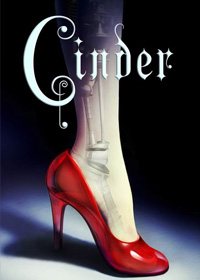
CINDER and the Triumphant Return of PROJECT CINDERELLA!

Holy mackerel, I almost forgot about Project Cinderella! My writing buddy Em Lord mentioned in passing that she was reading CINDER by Marissa Meyer, and I kind of shrugged at first, until I remembered that Em has impeccable taste and I shouldn't be so snobby about seemingly 'girly' stories.

I read it. I liked it. It followed me around for several reasons we'll get in to later. But I must ask you: If the main character of this story had not been named "Cinder" would you still have identified this as a Cinderella story?

THE BASICS

In an earlier Project Cinderella post, I broke down your Basic Cinderella story. Let's go through the checklist for CINDER:
* Kind young woman oppressed/abused by family (not blood related) -- CHECK.
* Charming Prince, looking for a wife, hosts a party -- SORT OF CHECK (It's more complicated than that, but there is a fancy dance, and the Prince's rapidly concluding bachelorhood is a factor.)
* Step-family cruelly prevents Cindy from attending the ball -- CHECK.
* Fairy Godmother, pumpkin, mice, rags-to-riches transformation including beautiful gown -- NOPE (though Cinder does work on an old orange car, probably better identified as a lemon)
* Fairytale magic that expires at midnight -- NOPE
* A trademark Cinderella abandoned shoe -- NOT REALLY
* And, last but not least, the Happily Ever After -- (CINDER is the first of a 4-part series, but I'm guessing we'll get there eventually.)

On the surface it does have some of the basic Cinderella elements, but the Cinderella stuff is rather secondary to a bigger world. In the original fairytale, the story all revolves around Cindy - we feel sorry for her, we root for her, we want her to improve her circumstances. We don't usually think a lot about what else is going on in the rest of the Kingdom. CINDER shows us a much richer world through a wide-angle lens, and it's the richness of the world building that keeps you turning pages, even when the plot is easily predictable.

THE SPECIFICS

CINDER is an example of an okay idea brilliantly executed. It wasn't the what, it was the how. I knew what was going to happen. The "plot twist" is a little too obvious, if I'm honest - almost to the point of eye-roll. But the amazing thing is that it doesn't matter. You know exactly what's going to happen, and you still can't put it down. Time and time again we see examples of this and I never cease to be impressed by it. It's not the what, it's the how.

And now for a few definitions:
* A person is a human.
* An android is a robot.
* A cyborg is a human with robot parts.

The character Cinder is a cyborg. As a result I spent the whole time thinking: "Gosh it's awful that she's has to suffer being part machine, geez it would be awesome to be part machine." Because of her machine integration, she's has access to all of this extra-sensory information. She gets a little warning light when someone is lying to her. She can access the internets just using her retina without anyone realizing what she's doing. And, to top it all off, she's a gifted mechanic, so she can fix her robot pieces if she breaks.

This is where the "shoe" element comes in. One of her robot parts is her foot, and it does seem to become occasionally detached from her body - but, she never leaves it behind for anyone to find (and thank goodness, I don't think I could have handled that level of cheese, good job by you Marissa Meyer!). Well... I guess she kind of leaves it behind (in an out of sight out of mind way) when she gets a better one. So maybe I'm speaking too soon?

Cinder lives in a futuristic world where humans have fought a fourth World War and there are mean people living on the moon. We as readers get to experience some of the history of this world, painting with much broader brushstrokes than we usually get in a Cinderella kingdom. The story has an Eastern flavor, taking place in New Beijing with a lot of colorful bits of culture sprinkled in (see the Prince's coronation ceremony and all the traditions built in). And, best of all, we get a better appreciation for the Prince because we understand his role in ruling his country AND where his country fits in with the rest of the world.

BIGGER WORLD, BIGGER STAKES

When I wrote about Cinderella before, I noted that while the story has evolved over the years, the character of Cindy has not. The biggest changes have been with developing the character of the Prince. CINDER did an excellent job defining Prince Kai's wants and motives in the scope of his royal responsibilities.
* His country is being ravaged by an awful plague.
* His father has just caught the plague.
* There is no cure for the plague.
* He will soon be the Emperor.
* AND, if that wasn't enough, he spends the whole book teetering on the brink of war with the mean people who live on the moon (who caused the plague in the first place).

The story is told in 3rd person, bouncing between three different points of view - probably 70% Cinder, 29% Prince Kai, and 1% the Doctor guy, who I guess is the equivalent of the Fairy Godmother in that he seems to have all the answers (and at the end he does facilitate a sort of transformation for our Cindy). The ~29% Kai gives us the keys to his motives - we know what he wants, we know why he wants it. We love him for it. We understand what is at stake for him. It's nice, actually - I would contend that the Prince character grows and changes more than Cinder does.

Cinder's character is pretty much the same at the end as she was at the beginning. She's learned a lot of new facts about herself and about the world, but they didn't really change her character. She was always brave, always kind, always mentally tough - and I think she knew all of that about herself. Deeper in the story, she makes different decisions based on the facts at hand, but nothing fundamental about who she is has changed. The Prince, on the other hand, is forced into a lot of iffy situations that test him - at the end of it all, he's proven a few things to his people, his enemies, and himself. He has a better handle on who he is and what he can handle than he did when the story first started. His character shows more development, more growth.

The characters are good, but not great.
There's nothing wrong with the plot, but it at times walks the edge of corny in its predictability.
The strength of this book is in the world building - you want to stare at it like something visual, drink in the sights of Asian inspired Sci-Fi - the jade and pink blossoms and archaic paper fans. It's tactile, the metal and the silk and the hovercrafts and the netscreens. And did I mention the mean people who live on the moon? Yeah, they're shiny and they can do mind magic. I just want to stare at it. It would make a phenomenal graphic novel. Or Pixar movie.

BUT...

I would contend this is a David and Goliath story disguised as a Cinderella story.

Change the name of the main character from Cinder to Jennifer or Sarah. Take the shoe off the cover (which really, the shoe has nothing to do with anything anyway). Properly title her "step-mother" as her "guardian" or "foster mother" (and same with the "step-sisters").

All that stuff strikes me as mere marketing semantics - things that make readers say "ooo, Cinderella, I know what that means!" There's nothing wrong with that, but this story doesn't strike me as a true Cinderella retelling.

Cinder is a David, called upon to serve the crown with her mechanic abilities (much the way David was called upon to serve with his music). She ends up in a show-down with the leader of the mean moon people (her Goliath). There is no make-over transformation, but there are a few miracles. That's the big difference - Cinder stays Cinder, both inside and out. No magic dress, no glass slipper, nothing beautiful expires at midnight. At least, not yet.